
This might just be another way of saying something I keep coming back to: you’re only as good as what you build that still exists.
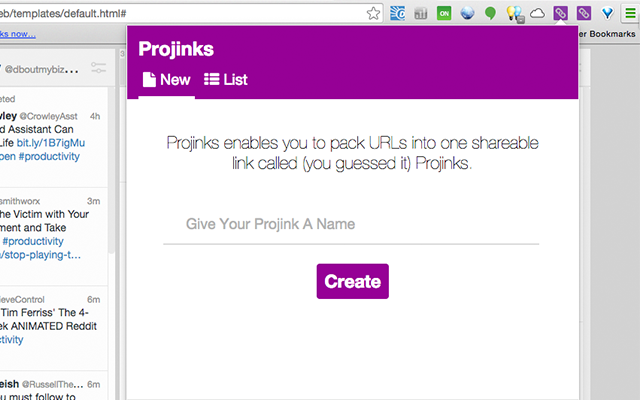
There’s a quiet power in creating something that survives time. Not because it scaled, or succeeded commercially, or even found its audience — but because it endured. Untouched. Still functional. Still standing.
Projinks is one of those things.
About 11 years ago, I set out into what felt like an exciting frontier. Browser extensions and apps were starting to hint at a different future for computing — one where tools lived closer to the individual. I didn’t see a better place to solve large, shared problems than right in front of the person experiencing them.
The idea was simple, maybe even a little idealistic: we’d all have personal toolkits, assembled to suit us, used almost like trading cards. So I did the thing I knew how to do best at the time — I started tinkering.
Back then, a browser extension could be little more than a pointer into a larger app. That felt like an easy on-ramp into the Chrome Web Store, so that’s where I began. The only catch was that the app it was supposed to link to wasn’t finished. Some critical pieces weren’t worked out yet. And hovering over everything was the question I kept circling instead of answering:
How am I going to monetize this?
That question is part of why this series exists. Left to Build is, in many ways, about what happens when you focus too much on outcomes instead of construction. If I had worried less about where it was going and more about simply building, this story might look very different.
Still, building that first extension was deeply rewarding. This was before hot reloads and instant feedback loops were common. Working directly with the DOM and browser APIs felt different than the web work I was used to — more intimate, more mechanical. Looking back now, what I built holds up better than I expected. It was safe. It had a decent user experience. And it left plenty of room for growth based on early feedback.
Then life moved on.
Fast forward 11 years. The Chrome Web Store doesn’t look radically different, but somewhere along the way my extension was flagged. I hadn’t touched the code in over a decade. Yet to my surprise, it had accumulated downloads and activity — a quiet signal that something I abandoned was still being used.
Curiosity got the better of me. I wanted to see what it would take to revive it, even minimally. It turned out to be almost comically simple: update a manifest setting, replace a deprecated API call, and suddenly everything turned green again.
In real life, a car sitting idle for a year needs serious inspection before it’s roadworthy. This? I pushed a new version the same afternoon.
Do I love the app as it exists today? Not at all.
Am I embarrassed by it? Not really.
For something that hadn’t received a single line of code in 11 years and still runs — it deserves some respect.
I’m not fully focused on Projinks again, but I’m also not ready to let it go. If nothing else, it stands as proof that building something matters. That time doesn’t automatically erase effort. That unfinished work still counts.
If you’re curious, you can check it out here:
https://chromewebstore.google.com/detail/projinks-beta/mjkchkgjmhbhhkbhefmafkiaeadnheen
I’m taking feedback. And maybe — finally — I’ll get around to building the core of what this was always meant to be.